Cognitive Behavioral Therapy (CBT)

cognitivebehavioraltherapy

This will be my last week of cognitive behavioral therapy. I only tried it because my family pleaded but due to time and expense it is no longer an option. Plus I don’t think that I’m in that category of those whom it helps the most. CBT is a common adjunct to meds when the person with schizophrenia is stabilized but continues to have a baseline of functional disturbances. It is commonly done with exercises out of a workbook given to the client by the psychotherapist. CBT has both behavioral and cognitive aspects.

cognitive behavior therapy

Regarding behavior, CBT is supposed to weaken the mental connection to troublesome situations and thereby altering the reactions (fear, depression or anger). The cognitive component of CBT targets thought patterns and seeks to alter the emotional state and corresponding behaviors. My psychotherapist worked with me to make me aware of my irrational beliefs and alter them through cognitive restructuring (behavior modification). I did cognitive rehearsal and practiced different responses to different situations that I encountered. Not only did I have workbook exercises but I also was required to journal which this blogging assisted with over the time I tried out CBT. Overall the positive reinforcement and systematic desensitization helped me learn new tactics to handle my illness.

Magnetic Resonance Imaging

hospitalmri

At my request, my doctor set me up for an MRI (magnetic resonance imaging). I wanted to know more about the course of my illness and the prognosis. So he set me up for the MRI to determine a baseline point and then monitor how it changes down the line.

schizophrenia

My doctor said the above image shows a schizophrenic brain on the right as compared to a normal brain on the left. The gray matter (neuronal cells) and the white matter (fibrous connections) are shown. Volume is a major difference. With schizophrenia there are enlarged ventricles and reduced gray matter. There is also reduced volume in the temporal lobes and hippocampus which affect auditory processing, language and memory. I’m glad we chose to do the MRI because I want to know the structural and functional findings so it helps them consider what the possible outcome might be.

Course of Illness (Schizophrenia)

chart symptoms

My psychiatrist can’t confirm any possible course of my illness; but he does think that due to my later onset and of my being female that it will be milder. At this point on my vigorous medication regimen, I’m having essentially no positive or negative symptoms. He doesn’t think that there will be any deterioration in behavior or cognition. However, potential short-term working memory problems may arise and he also thinks that I may continue to have subtle peculiarities in my language (negative symptom).

Although, I’d have been the first to say that I never got depressed just anxious, it has been determined that I have suffered from depression and may continue to do so. My depression is an anxious case not the sad states. Fertility and fecundity are a non-issue for me as I’ve already raised my four kids. And my doctor doesn’t think that life span will be decreased but I am at risk for diabetes and high blood pressure due to the medication side effects.

As for the meds, I have to be symptom free for a year before he will cut back on any one or better yet discontinue all. He worries about the statistic of 90% recurrence within five years of stopping meds. So, that was the extent of my discussion with my doctor today.

Psychosocial Treatment

angelagreyI’ve been receiving psychotherapy since I was twelve plus in and out of group therapy from the age of fifteen. So why is it now that I’m being prompted to add other psychosocial treatments to the mix. I know the response: to improve socialization. However, doesn’t class work count towards psychosocial therapy?

Psychosocial treatments include cognitive behavioral therapy (changing negative thought patterns), family education, occupational therapy, group and family psychotherapy, and cognitive remediation. They are thought to help lessen schizophrenia symptoms, learn new skills, help in coping with the illness, prevent relapse, and achieve a connection with others.I already learn new skills from all the classes that I take. Regarding the compensatory learning strategies, I think the classes I’m in also aid in memory, planning, organizing, and concentration.  I think this blogging helps, too. It allows me an outlet to journal experiences each day. In that way, it will aid in preventing relapse by getting feedback from my family members in order to stay focused on being mentally healthy.

My Phases of Schizophrenia

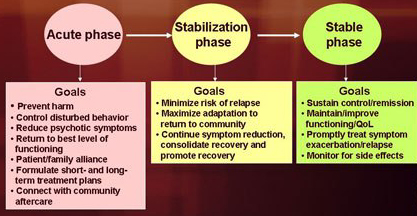
phasesDuring my acute phase, my family practice doctor sent me to the emergency room which resulted in a diagnosis of psychosis and schizophrenia. My general practitioner thought that I was in danger of harming myself or my family. I couldn’t control my own behavior, primarily my emotions, and I had limited functioning. Fortunately for me, my family was a strong support structure. In addition to the treatment, I also had a strong connection with my community aftercare team; they called twice daily to make certain that the anti-psychotics were working well.

Now that I’m in my stabilization phase, I’ve returned to the community and work (architectural drafter). I’m an avid reader and perpetual student; there is always something that I want to learn or try. I’m not a real risk taker though, so there are still obstacles in my way. I continue on my path to symptom reduction and have every intent of remission and even more improved functioning, particularly socially.

Positive vs. Negative Symptoms for Me

strengthThe positive symptoms (in addition to reality) of schizophrenia are: hallucinations (see and hear things), delusions (false beliefs that defy reasoning), paranoia, disorganized thinking,and grandiosity (believing that I have supernatural powers),

And the negative symptoms (lacking from normally considered behavior) are: lack of emotion, slow speaking, poor hygiene, impaired memory, poor concentration or decision making skills, limited social functioning, lacking motivation, and inability to experience enjoyment in things I once found pleasurable.

I’ve highlighted the ones that I experienced. In addition to those, I experienced sleeplessness, OCD, depression, and high anxiety. All of my symptoms have been treatable. I do still experience hallucinations when the stresses in my life are too great. Things haven’t gotten easier for me; instead, with the aid of medication, psychotherapy and my support structure, I’ve learned what is and isn’t real. I can control my emotions but I still have trouble relating to other people because I fear that my symptoms may arise in their presence. But the key is that I am in control and feel empowered.

Contrary to myths, as a person with schizophrenia, I don’t have developmental disabilities, violent tendencies, or a split personality. Not being in contact with my birth family, I don’t if genetic susceptibility or environmental factors (nature or nurture) played a role. I was diagnosed with PTSD years back due to physical and emotional trauma as a child; but I believe those are irrelevant at this point in my life as I’ve gotten over and forgiven all responsible. I truly hope they are as happy as they can be in their own part of this world.

At this point, the medication works but isn’t without side effects. The worst of all is the tremors. However, restlessness comes in a close second. All in all, I prognosticate that I will be in full remission (symptom free), with the aid of medication, within six months time.

Suicidal Tendencies

Hi, my name is Angie Grey and I attempted suicide at the age of seventeen while I was pregnant. It was within six months after being released from the psychiatric ward. I jumped off a train bridge in Bismarck, North Dakota and was rescued by a boater in the water beneath me. I didn’t realize how lucky I was for him to be there that late at night because I didn’t know how to swim and was sure to die. For a long while, I was okay with living up until May of 2009. At that point, I had a suicide date in mind. Fortunately for me, I found Pathways Health Crisis Center in Minneapolis. At that time, my next door neighbor, Angela had committed suicide and I was in full blown delusion. For years, the dead woman living in my home urged me to take my life just as she did my neighbor. My grandiosity was that I could see through walls to the adjacent townhome. I saw my neighbor laying in her bathtub, with pill bottles and a bottle of wine in hand. All the while, the dead woman who lives inside my home was telling me that life wasn’t worth living. Most recently, during my psychotic break, the dead woman said my new neighbor is planning on taking his life too; but this time it will be with a gun and due to the constant hip pain he is experiencing. She (the dead woman) continued to tell me and show me how obvious it is that life isn’t worth living. Look at all the suffering. Thanks to my medicine, I see this isn’t real. Fortunately for me, I have a strong support network and Pathways as well. I feel bad for the others that don’t!

About Me and Schizophrenia

My onset of schizophrenia didn’t occur until long after I’d left home. I was twenty-six years old and just starting college when the hallucinations began. During Fall semester in 1996, I met a fellow student named Holly. She said that our Psychology professor liked me.It wasn’t until I started having dreams of my being murdered that my life with Holly and my professor became more chaotic. It was sometime in November 1996 that the first nightmare occurred. In the dream, I went for my daily walk in Normandale Lake Park. I was on the south side when my Psychology instructor saw me and smiled. I turned away embarrassed and when I looked back he was so close then I saw his face. He was raging mad and lunged at me. I saw my long blonde, curly hair fly in front of my face. Then I felt his hands struggling with me and then he was on top of me. I didn’t have time to scream in my dream; however, I always woke screaming.

Holly didn’t like me talking about my dreams. It disturbed her because she thought that it couldn’t be me since I never had long blonde hair. Instead, the thought it was an older female that I knew back in high school. Holly thought that maybe I subconsciously wanted that former acquaintance dead but she was wrong. I didn’t. I swear. As the dream progressed, I realized that it wasn’t me in the dream but Holly. That is when she started getting more upset about me talking about my dreams, so I stopped sharing them with her.

Anyway, our college lives became anxiety-ridden, especially since our Psychology teacher started following us around. He was also faculty advisor so he was friends with everyone, meaning he was everywhere: in and out of our other classrooms. Then the maintenance men started watching us, too, particularly me. It didn’t matter where I sat (lunchroom, out front, in the Japanese garden, on hallway floors, in the library or computer center), our Psych professor would find me.

The dreams went on for months when one day I was watching television while doing dishes. At that moment, my body froze. I saw her—the blonde with long hair that was being murdered in my dream—and knew immediately who it was. It was my friend, Holly! The news report said that a pedophile had killed her in Normandale Lake Park. It couldn’t be right.

During my psychotic break, I was hallucinating visions and voices as well as deep in delusion. I was seeing a dead woman in my house as well as my deceased grandma and aunt. In addition, I thought I could walk through as well as see and hear through walls to my adjacent neighbors townhouse. Plus, I was deep in paranoia in thinking someone was following me wherever I went.

My psychotic break or nervous breakdown occurred over a six month period. Initially there were confusing voices and overwhelming smells but that progressed into debilitating paranoia, delusion, and non-stop hallucinations. I refused medication because I thought it would cloud my thought processes which were relaying danger, danger, danger…. I was worried that my family and I wouldn’t be safe if I took the medication. I thought the dead woman that lives inside our home would cause us harm. Plus I was concerned that it (meds) would control my thoughts and take over our wellbeing so that we couldn’t deal with the watchers. In reality, it was all unreal. In the emergency room, I was forced to take Seroquel which knocked me out. It was in the moments upon awakening  that I realized all the voices, visions, smells, and sounds STOPPED. It was quiet for the first time in a long while. Fortunately, for me, family members made certain that I stayed on the medication regimen. Yes, it has gone through changes where I’ve had to switch meds but all in all the majority of the hallucinations and delusions have stayed away. Stressors still bring on bouts but for the most part the drug therapy helps. At first, I kept in mind that I could always stop the meds and bring back the positive hallucinations; but now I know the bad will come along with the good. While I miss the visions of my deceased grandma and aunt, I don’t miss the bad spirits.

 I’m also an enrolled member of the Sisseton-Wahpeton Oyate. Thanks in part to fantastic foster parents, sassy social workers, and outstanding teachers, I’m also a family-focused parent of four wonderful young adults. I’ve self-published one memoir under my own name and four fiction novels under a pseudonym, Peyton Mathie. Those accounts were based on my life stories. Although I’m a native of the Lake Traverse reservation in South Dakota, I  lived in Brooklyn, New York off and on throughout my childhood. Currently, I reside in Eden Prairie, Minnesota with my family. My hobbies include yoga, MBSR, camping, budget travel, and painting.

Note: The pseudonym was derived from the first name of my daughter’s childhood friend and the surname of a coworker at approximately the same time frame. In one I saw signs of my past and the latter, hopefully, my future.